Monday, August 13, 2018

DEMOCRACY IN INDIA

Judiciary, election commission, media, and statistics are the four pillars of democracy which keep it authoritative, functional, dynamic, and accountable. If any or all these institutions are damaged, corrupted, compromised or abused, democracy becomes meaningless or even collapses.

The case under observation is democracy in India.

CANADA’S TWITTER ATTACK ON S.ARABIA SEEMS HYPOCRITICAL


Canada’s Twitter diplomacy in condemning Saudi Arabia has not affected the latter's tormented human rights record, especially against women. Instead, it generated anger and overreaction from the Saudi leadership resulting with lightning speed the withdrawal of diplomats, investment and trade, stopping of flights and immediate return of the Kingdom’s students from Canada.

The question is why the Canadian foreign affairs minister Chrystia Freeland used the Twitter channel to raise the issue instead of traditional face to face dialogue. Presuming the minister and her advisory staff are not naive in their concern for human rights in Saudi Arabia, the motive has not served its desired purpose. Rather it has been a disaster toward Canada-Saudi relationship.

The feud has not only wiped out the friendly influence which Canada could use over Saudi Arabia in its grave violations of human rights, but it has generated another conflicting spot in the world already dotted with tensions and violence.

In its open denunciation thru series of Tweets against Saudi Arabia’s adamant violation of human rights, the government has won nil support worldwide. But the Leftist community seems to applaud the Liberal government as it is very well aware of the credibility of Canada on this issue.

Canada has its own bad record of human rights violations as well as its known double standards in observing complete silence when its biggest trading partner, the USA, has committed much more serious human rights violations all over the globe including Vietnam, Iraq, and in Afghanistan.

-Promod Puri

LEFTISTS' HERO FIDEL CASTRO LEGACIES


Fidel Castro, the hero of the Communist-socialist world of the Leftists, was born 92 years ago on August 13,1926.

The 1959 Fidel Castro’s armed political revolt had a utopian communist promise of prosperity for Cubans. With massive Russian aid, the country survived in meeting the basic needs of its people, and that included Cuba’s pride declaration of free education and the “best” medical system in the world.

The dictatorial regime of 60 years of Castro did not turn the political revolt into an economic revolution. Moreover, typical of authoritarian and Communist regimes freedom of speech and expression were and still being curtailed. Since the early 60s, a generation has been fed on leftist ideologies. A mindset attitude has been created with the egoistic attitude that its political ideology is better than capitalism.

That is the true legacy of Castro apart from popularizing his favorite drink of Mojito, a refreshing cocktail of rum and fresh mint leaves.

-Promod Puri

Saturday, July 14, 2018

TIME TO ABANDON GDP


GDP, annual gross domestic product, is the sum of all the goods and services produced by a nation. It numerically indicates the economic growth of a country. But GDP numbers can be manipulated, especially in controlled socialist regimes and by so-called democratic governments across the globe.

Besides vulnerable of being corrupted by the deceiving governments, GDP is a flawed measurement to present the true picture of a nation. After all, the economy is not the only valuable indicator of how a nation is doing. There are equally other factors such as inequality, well-being, happiness, and environment, which are important as well for the overall development of a nation.

For that reason, GDP is now considered an outdated measurement which needs to be replaced by UN-supported indicators which include other factors besides the economy. These factors also include poverty, wealth inequality, public debt, etc. Also, to be considered the value of services provided by social media and the digital goods and services like Wikipedia.

GDP needs not be a single number.

by Promod Puri

Thursday, July 12, 2018

DRINKING WITHOUT STRAWS


The big environmental cheering is that Starbucks plans to discard the use of plastic straws globally by 2020.

Perhaps, the time-frame of two years is needed so the customers can learn or simply de-habituate themselves to enjoy Starbucks cold beverages without straws.

Straws for drinking purposes are certainly a big environmental wastage. They are part of the eight million plastic tons of new plastic entering our oceans every year and stays there. If the trend continues, it is estimated that in 32 years from now oceans will contain more plastic than fish.

Drinking thru a straw has never been a habit nor fascination for me. I always considered it an elite usage, which is not natural and a pure wastage because of its one-time use only.

Drinking without a straw has its own pleasure. Straw delays the taste. Perhaps Starbucks has realized it too.

-by Promod Puri

Monday, July 9, 2018

Time To End Cricket Hype With Football


Cricket has been a national obsession in most of the developing and Third World countries.
It is about time that the game should be dropped from the status of being the most popular sport. Rather football, aka soccer, must be promoted as such.

Despite generating millions of fans in countries like Afghanistan to Zimbabwe along with India, Pakistan, Bangladesh, Sri Lanka, etc., from a crop of only a few hundred cricketers, that a needed exit from its elevated prestige is worth for the survival and flourishing of other sports.

Over the past half of century, cricket has so much dominated the sports scene in South Asia, parts of Africa and Europe, the Middle East, and Caribbean Islands, that most other equally worthy sports have been discriminatorily relegated to lower grades.

Cricket is an elite sport. It has acquired its status symbol among the middle and rich people. It is an expensive outdoor indulgence. A vast majority of poor youths can only enviously enjoy watching it (only on TV). But they can not actively participate in this “gentleman’s game.”

Compared to that the “common man’s game” of football is an all-inclusive sporting event. It is undoubtedly the most popular of all the world sports. It costs only a few bucks to buy a football. In cricket, the total cost for all the equipment, bats, balls, wickets, and the protective gears runs into thousands.

Not only that, in cricket of all the 22 players comprising the two opposing teams, just three players, two batsmen and a bowler, actively play the game at a given time. The rest of the 10 players supporting the bowler are fielders. They come into action only when the ball is delivered in the direction of any of them. Still, the nine players from the batting side are sitting idle waiting for their turns to bat which may not come at all for some or most of the players. The players are in the game, but not playing!

And many times, the stretched out the game just drags on. The thrill of either playing or watching the game is taken over by yawns, even brief naps too. Perhaps patience and boredom are essentials in the cricket regime.

Now, let us compare it with the strenuous game of football. One ball and that is it. Cheap and very much affordable. And all the players, 22 of them, are involved together in the vitality of the game. They are running, jumping, hitting, and bouncing in an action-packed and meditative focus on the ball. Full value for both the players and spectators.

The downgrading of cricket from its elite status will help the game of football to cover more ground involving every economic class of youths for their much-needed physical activities.

In Britain after all, where the game originated and exported to its colonial domains, cricket is gradually receding in popularity. It is being replaced by the more lucrative sport of football.

It is about time to end the cricket hype. It has gone too far. And let the football kick in.

By Promod Puri
promodpuri.com

Friday, June 29, 2018

With Small Doses Of Capitalism Cuba Can Achieve Its Socialist Idealism

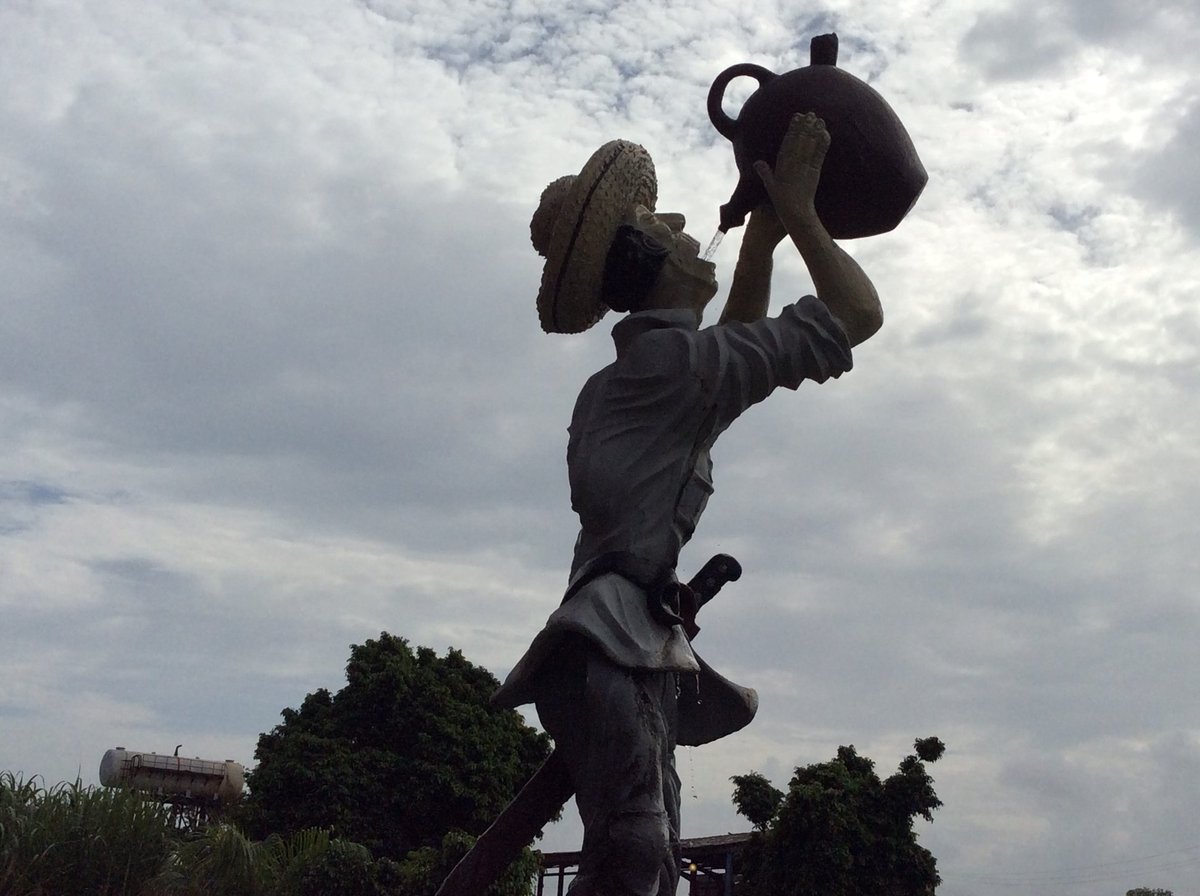
Sculptor in the sugar factory of machete man to recognize the tough job of harvesting the sugarcane fields manually. Photo and Caption by Rita Puri

Part 1: Life In Cuba

Rather than the politics of communism or socialism, the face of Cuba is much reflected by its vibrant culture. In their healthy and shining look, most Cubans seem to be hardworking and contended folks who, more than anything else, enjoy their music, dance, and simple food loaded with organic fruits and vegetables.
The cultural and social aspects of Cuban lifestyle has an aristocracy and sophistication which has a class of its own in this classless society. The three most important ingredients of its cultural pride are coffee, rum, and cigar. And in that order, the popular Cuban custom is the after-dinner ritual of having coffee followed by sipping espresso or regular coffee and finally enjoying the smoke from their rooted obsession, the cigars.
Cubans, perhaps don’t care in which brand of political isms they are being ruled but they do love their customs and traditions doused with music, dance, coffee, rum, and cigar. And that could be the reason for their blissful life along with the year-round balmy weather.
Part 2
With Small Doses Of Capitalism Cuba Can Achieve It Socialist Idealism
Cigar, rum, and coffee beside being Cuba’s cultural identities also have therapeutic value in relieving the psychological hardships being faced by Cubans under decades of its “revolutionary” regime.
The 1959 Fidel Castro’s armed political revolt had a utopian communist promise of prosperity for Cubans. With massive Russian aid, the country survived in meeting the basic needs of its people, and that included Cuba’s pride declaration of free education and the “best” medical system in the world.
The dictatorial regime of 60 years of Castro did not turn the political revolt into an economic revolution. Moreover, typical of authoritarian and Communist regimes freedom of speech and expression have been almost curtailed. Since the early 60s, a generation has been fed on leftist ideologies. A mindset attitude has been created with the egoistic att
itude that its political ideology is better than capitalism.
Besides food, shelter, and healthcare, there are other earnest urges basic to the human nature. As the world has become much smaller thru Internet, these urges seek same opportunities as naturally available to free societies. The urge to express, explore, google, communicate, travel, educate, learn and earn is the aspirations which are denied, limited or switched on or off in the restricted political societies.
In Cuba, with the explosion of information thru social media and Internet, the country’s leadership has realized the prosperity of its people depends more than just earning few export dollars from rum, coffee or cigars.
While still under the shadow of Communism, Cuba is undergoing an economic revolution with capitalism making inroads mainly thru its emerging tourist industry. Capital is also flowing from thousands of professional Cubans residing abroad, mostly in Central and South American countries, who are regularly repatriating huge amount of funds which boost the nation’s economy.
With idealism of socialist goals along with a controlled allowance of capitalism, Cuba seems to be carving a right path towards social and economic achievements for the ultimate prosperity of its people while protecting its natural environment.
-by Promod Puri
(This article was written recently while on a two-week vacation in a Cuban resort hotel)